
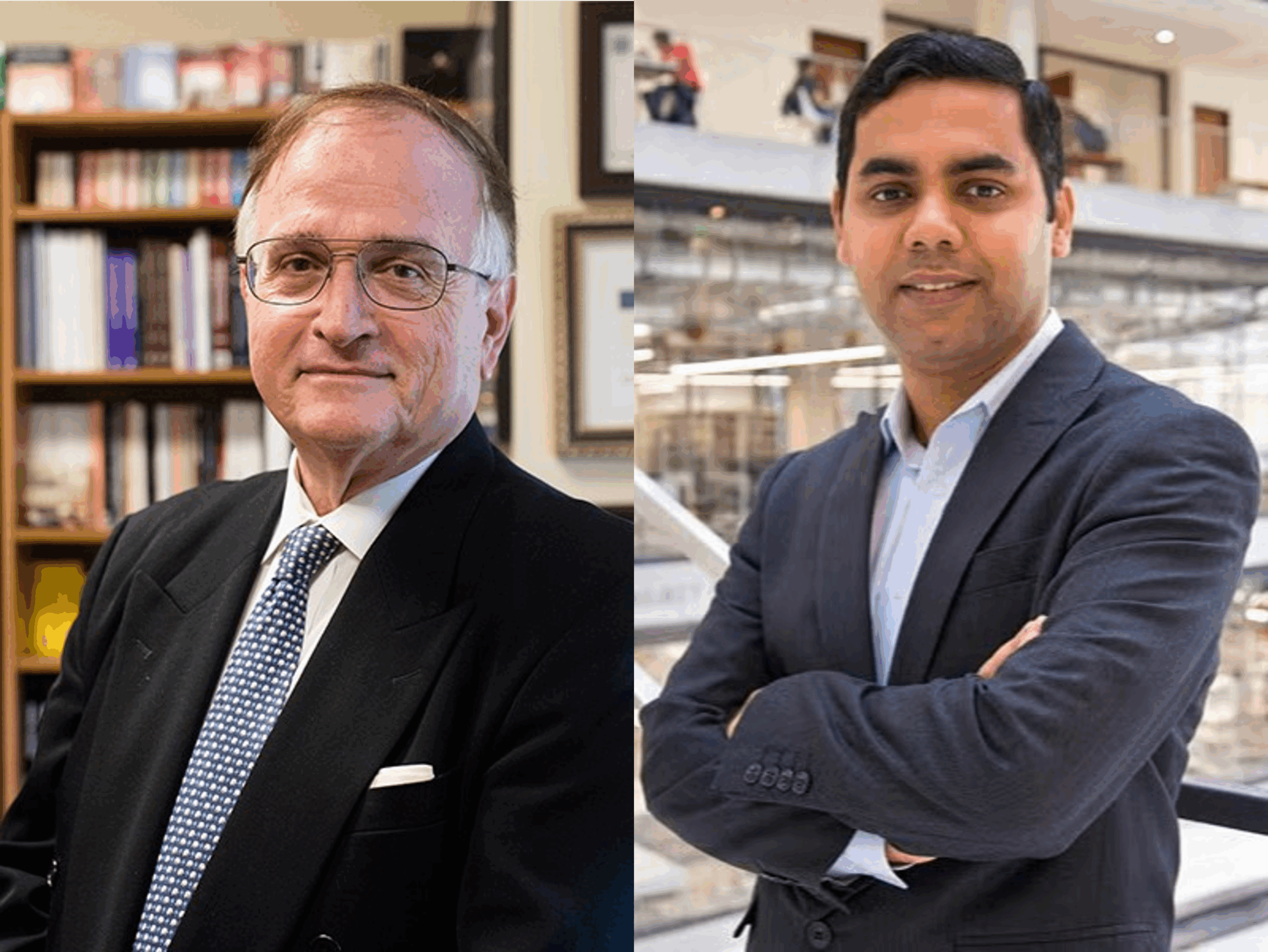
Texas Engineers Nicholas Peppas (left) and Jaydeep Kulkarni (right)
A pair of Texas Engineers, Nicholas Peppas and Jaydeep Kulkarni, have been named Fellows of the Institute of Electrical and Electronics Engineers (IEEE).
IEEE Fellow is a distinction reserved for select IEEE members whose extraordinary accomplishments in any of the IEEE fields of interest are deemed fitting of this prestigious grade elevation.
Each year, this honor is limited to no more than 0.1% of the total IEEE voting membership. Fellow is the highest grade of IEEE membership and is recognized as a prestigious honor and an important career achievement.
Peppas was honored “for contributions to engineering design, modeling, and optimization of therapeutic delivery agents.” He is the director of the Institute of Biomaterials, Drug Delivery and Regenerative Medicine. He is the Cockrell Family Regents Chair in Engineering # 6, and he has appointments in the McKetta Department of Chemical Engineering, Department of Biomedical Engineering, Dell Medical School and College of Pharmacy.
Peppas’ research lab contributions have spanned several areas of drug delivery, biomaterials, biomolecular engineering, mass transfer, kinetics and reaction engineering, polymers, and biomedical engineering. Their multidisciplinary approach in biomolecular engineering blends modern molecular and cellular biology with engineering to generate next-generation systems and devices, including bioMEMS with enhanced applicability, reliability, functionality and longevity.
Kulkarni was recognized “for contributions to low-power SRAM and compute-in-memory circuit technologies.” He is an associate professor and holds the Fellow of Silicon Laboratories Endowed Chair in Electrical Engineering in the Chandra Family Department of Electrical and Computer Engineering at The University of Texas at Austin.
His research focuses on Integrated circuits and systems, specifically machine-learning hardware accelerators, low-power digital designs, in-memory computing, DTCO/STCO for emerging nanodevices, heterogeneous and 3D integrated circuits, hardware security, cryogenic computing, and superconducting electronics.