
Breaking Down the Battery Problem
A researcher at the Cockrell School of Engineering is continuing a legacy of battery science that began right here at The University of Texas at Austin.
Consider the humble rechargeable battery: Many people start their day by unplugging their phone from a charger to check the weather or commute to work, or throw on their favorite podcast. They’ll end the day by plugging in their phone to charge again overnight.
This cycle represents decades of battery research pioneered right here at The University of Texas at Austin. Without the small, energy-dense, and safe lithium-ion battery, our morning routine would be very different.
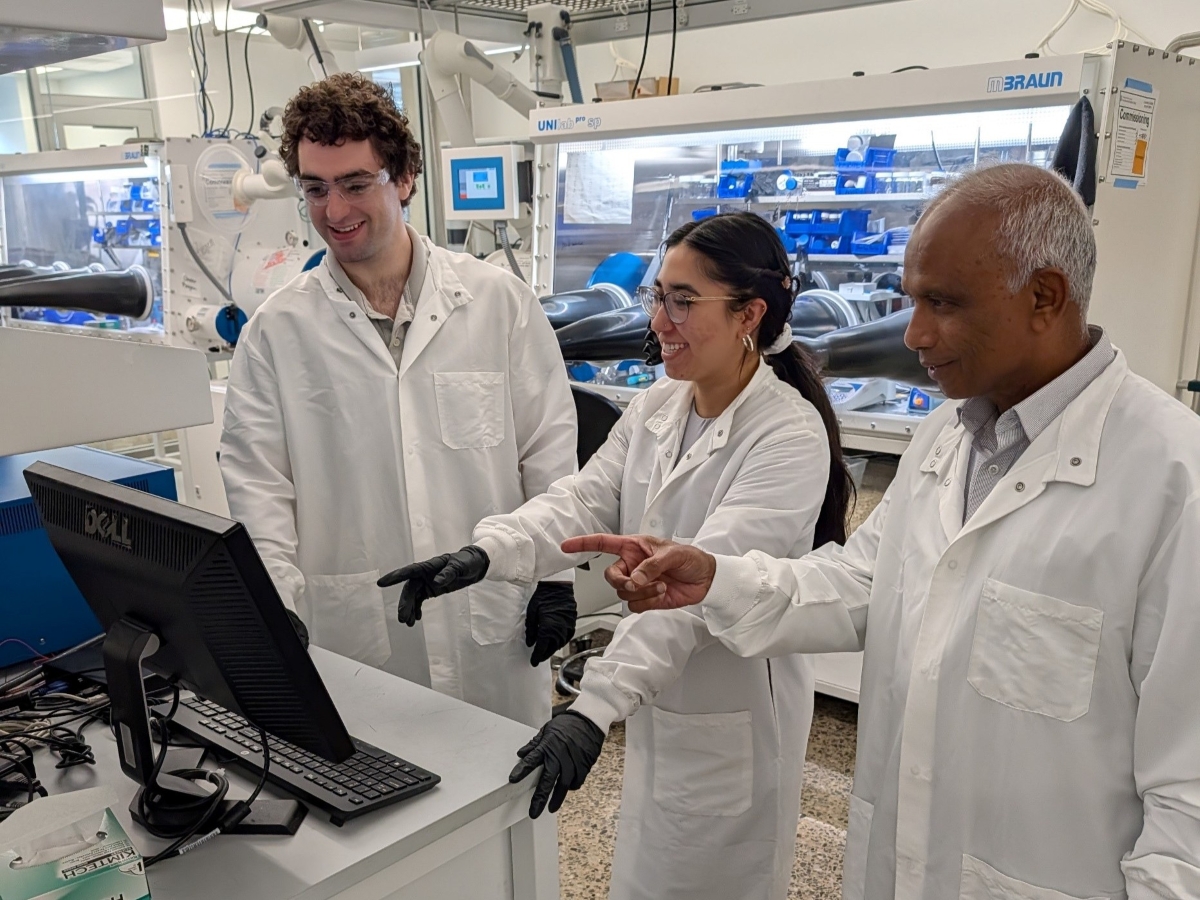
“Even if you come up with other battery technologies, lithium-ion batteries will still be there,” said Arumugam Manthiram, a professor in the Walker Department of Mechanical Engineering. He has been working on the chemistry that happens inside batteries at the Cockrell School since 1986. “It might be replaced … but that will be a slow [process] if it is ever going to happen.”
His latest research, published in Nature Energy, explores a framework that could be used to advance a crucial part of lithium-ion batteries. Roughly 75% of the cost of lithium-ion batteries is the materials, and the majority of these batteries use expensive oxide cathodes. This is the problem Manthiram and his students are tackling: How do we begin to make these oxide cathodes more efficient?
Texas Engineers are already working on creating batteries made from more abundant—and more environmentally friendly—materials like sulfur or sodium, but this tech is still in the prototype stage. While this tech is promising, “it’s one thing to do something in the lab, and it’s another thing to make it, put it in your hand, and use it,” Manthiram said.
Why Fundamental Research
Lithium-ion batteries dominate the rechargeable market for their safety, power-to-weight ratio, and long cycle life, which means long-term reliability. The lithium-ion battery market was estimated to be worth $60 billion in 2024. That number is expected to triple in the next decade as demand for more efficient electric vehicles and energy storage rises.
Yet, sourcing the materials necessary for these batteries is becoming tougher, not easier, as supply chain disruptions from local conflict, politics, or environmental causes become more common.
A cathode, the positively charged electrode, is one of three essential components to a battery. It’s also the most expensive, usually making up half the total materials cost of a battery. The cathode is composed of nickel, but also lithium and cobalt, which are the mined minerals that are so vulnerable to supply-chain disruptions.
Understanding how these materials mix is crucial to meeting future market demand, keeping costs down, and maintaining safety.
“It involves a lot of fundamental knowledge. That’s where I come into the picture,” Manthiram said, “The cathode needs a lot of fundamental chemistry and physics knowledge to make it behave properly in engineering.”
Manthiram worked closely with Nobel Prize winner John Goodenough at Cockrell, who is credited with inventing cathode materials for lithium-ion batteries in the 1980s and which has revolutionized our morning routines.
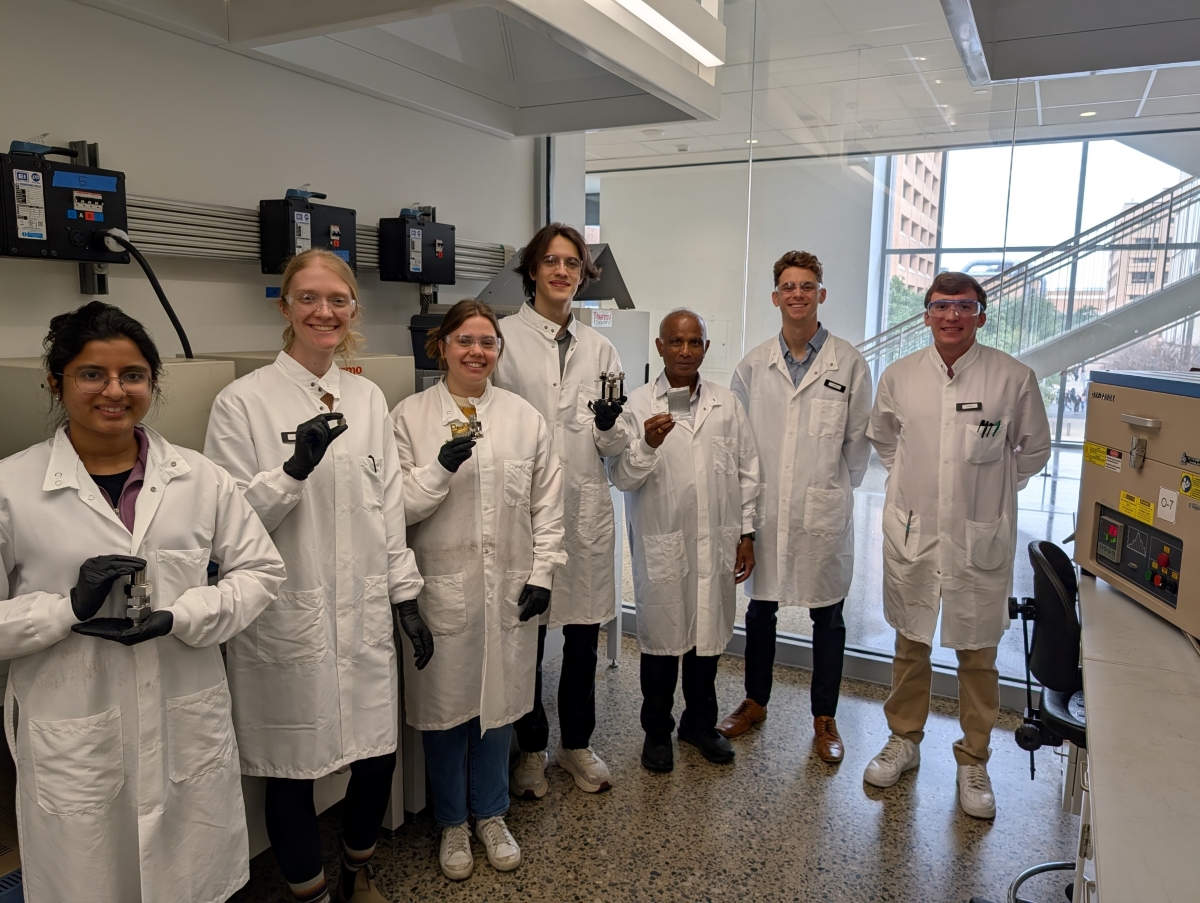
Now, he’s working with his own “wonderful” students and postdocs to push the technology forward.
The Nature article breaks down the complexities of oxide cathodes and how machine-learning datasets can become valuable to speed up the development of future batteries.
Manthiram identifies three factors of the oxide cathode that control its behavior and properties: electronic configuration (or, how the electrons are arranged in the atoms of material), chemical bonding and chemical reactivity. Each of these individual parts of a cathode’s equation affects the battery’s performance.
Different chemical bonds can shift operating voltage and alter thermal stability and safety. Chemical reactivity can affect gas generation and cycling stability. Electronic configuration can determine which materials should or shouldn’t be grouped together. Even something as stable as iron can have adverse effects when paired with lithium in an oxide cathode.
That’s a lot of data to handle. Understanding the influence of these factors well would take years of research and significant resources, but the broader materials industry is already training machine learning algorithms to assist experimentalists in their work.
“You cannot depend only on machine learning or artificial intelligence. You also need human intervention. That means whatever comes out of that [research], we better understand what it is.”
Why AI Matters in the Frontier of Materials
There are already examples of AI being used to take advantage of huge datasets and predict promising leads for researchers. Google DeepMind’s GNoME project predicted 528 new compounds that could potentially be lithium-ion conductors. There is some discussion as to just how novel or useful of these compounds could be, but that’s where scientific expertise becomes paramount.
Manthiram’s group is using Texas Materials Institute’s facilities to conduct characterization experiments, which create complex datasets that AI trained by the group can then parse. After that, the experiments are done again, repeating the cycle of creating data to train a ML-model to predict materials to experiment on.
“We invent the materials; we invent the process in academic labs; and then [industry] has to scale up and implement it,” Manthiram said.
Pushing the technology forward, reducing the amount of cobalt used, overcoming the instability concerns of more nickel in the mix. These are all bite-sized solutions for a big challenge that affects everyone.
“I tell my students, we’re all learning. That’s the attitude I have.”
Manthiram hopes this article builds on an educational framework and pushes researchers towards a better understanding of cathodes, which in turn would speed up development while reducing safety problems.