
Barista Bot Brainchild of Texas Engineering Grad
This startup is fueled by a passion for accessibility, sustainability and quality caffeine.
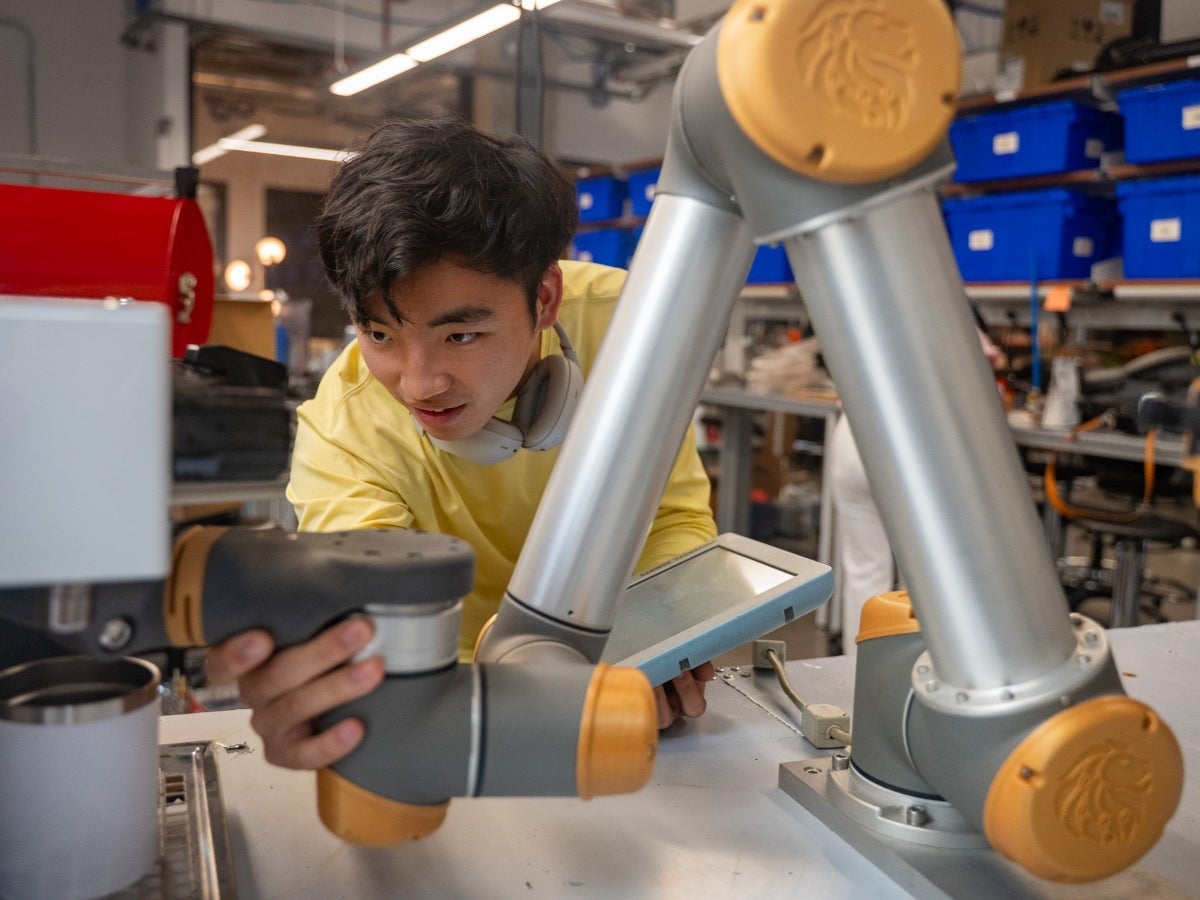
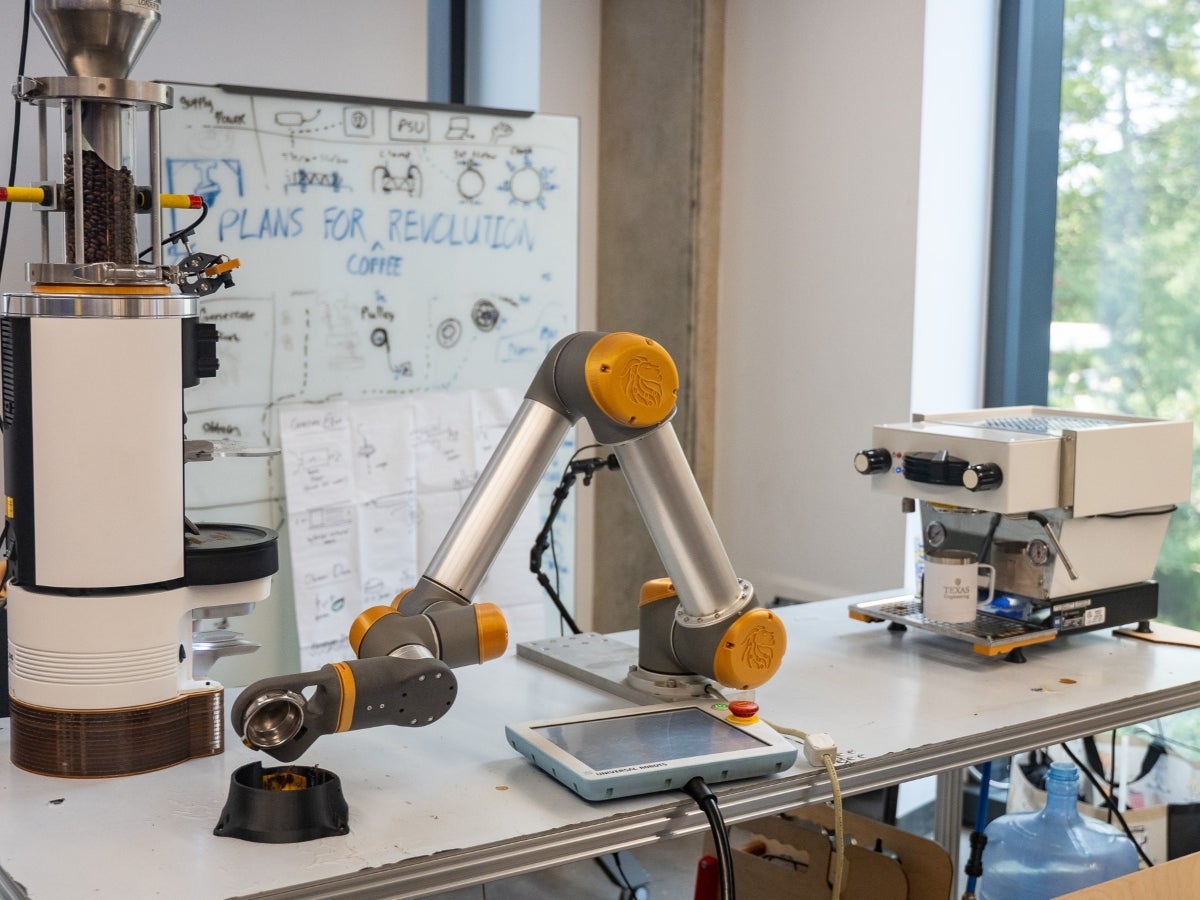
Remy is a barista—specifically, an espresso expert. It doesn’t matter if it’s the middle of morning rush or last call, the beans are loaded into the grinder smoothly, tamped and pressurized with fine precision on any espresso machine model. Each hot cuppa is pulled right on time, no order forgotten, no beans burned.
Remy is also a robot.
The brainchild of Jason Wang, a recent graduate of the McKetta Department of Chemical Engineering at The University of Texas at Austin, Remy’s journey to functional barista has been full of twists and turns. It started as a simple idea to answer a simple problem.
Catie Nunn (B.A. exercise science 2025), Wang’s girlfriend, is a big fan of lattes in the morning. Wang was a big fan of sleeping in.
“What if I just bottle espresso so that you can have your week’s supply of coffee at the ready?” he thought.
Nunn and Wang now co-own Saja Drinks, the public-facing coffee business. The coffee cart is mobile, a countertop on wheels that could show up at any farmer’s market or event on the Forty Acres to develop a consumer base.
But the cart needs a reliable supply of espresso. They had to bottle the many espresso shots by hand while Remy was being programmed which was, “a little painful, but you know, you gotta do what you gotta do,” Wang said.
Like many entrepreneurs with a dream but no venture capital, Wang started with the everyman’s supply depot: Facebook Marketplace. He bought a Universal Robotics UR5 robot, which came from a duo with a broken brother programmed to make semiconductors. Rather than fix the broken robotic arm, the company elected to simply buy a new set, and Remy was put on the market. It was a lucky find.
With his engineering background, Wang has used a little bit of python, a little bit of CAD, which helped as he built it out in the labs of Texas Inventionworks. But mostly, he says, “Engineering has shown me how crucial it is to break large problems into smaller subsystems and then into manageable pieces to make the seemingly impossible—possible.”
Why go through all this effort for something as simple as fresh espresso?
The development of this bot, the cart, and his business is a trifecta of three high-level goals: taking down wasteful K-Cups, amplifying local coffee artisans and promoting sustainability with glass jars.
On a more practical level, a robotic arm and this packaging business offers greater accessibility to small businesses that might not need an entire barista, like bars serving espresso martinis. Though Wang says most espresso martinis are actually coffee concentrate.
Brian Batch is the owner of Bird Bird Biscuit, a local biscuit and chicken restaurant. Batch is also a former barista who would love to sell espresso and coffee products in his small shops.
Wang was curious about the hand-written containers of coffee beans behind the pick-up window of Bird Bird, and got Batch’s information from the staff. Batch received an email asking about how Bird Bird Biscuit sourced its beans and espresso, “and I really appreciated the thoughtfulness he put into the email.”
Batch has been working with Wang to provide business connections and review the process from a potential customer’s point of view.
“By talking to [Batch], I found out this issue: that restaurants don’t have or don’t want to spend the capital on human training or on an espresso machine,” Wang said. “Espresso machines are expensive; that’s just a fact.”
Quality home espresso machines start around $300, while commercial machines you’ll find at a coffee shop can run $10,000 to $30,000. This, on top of a part-time, skilled barista, just isn’t in the budget for many small businesses.
That’s where pre-bottled espresso could come in. It would provide a restaurant an easy “in” to a prohibitively expensive skillset, a server for bean roasters and different blends, or simply an extra hand during busy shifts.
In the long-term, the only waste being generated by the process itself is coffee grounds, which are biodegradable and compostable.
The road to success is fueled by caffeine
It hasn’t exactly been a lesson-free experience, however.
Wang had to learn how Texas cottage food laws work. He is currently figuring out how to service an espresso machine gifted to him by Batch, and he needs to reconfigure future robot-cart prototypes because of an incident in the fall that threatened the whole endeavor.
While Wang had measured for the width of the cart, he failed to account for the length, which meant he couldn’t get it through the elevator doors of the Engineering Education Research and Center.
“It really was a moment of, ‘Aw… this is a pickle,’” Wang said. “Luckily, there’s a freight elevator.”
And he’s had a lot of help. His business connections are huge supporters, and Nunn has been coming up with latte flavors and baking cookies to help augment sales to non-caffeinated friends. Wang credited her with helping keep his head on straight.
Wang began working as a battery manufacturing launch engineer at Tesla after he graduated, but he and Nunn plan to grow this into a fully-fledged business to compete with Keurig and other coffee corporations.
Remy now also has an assistant, Andrew Jones, a third-year electrical engineering student who’s helping refine arm movements.
Batch of Bird Bird Biscuit is just eager to see where the road takes Wang.
“I’m fortunate enough somebody reached out to me early in my journey,” Batch said, “I’m just trying to help him down the way.”
Whether it’s programing a robotic arm to serve perfect cups of espresso, or getting the coffee cart physically out of the building, “It’s just breaking down big problems into small problems, I feel,” Wang said. “That’s the biggest tool in the engineer’s arsenal.”