
Best of Both Battery Worlds
Researchers built a “bridge” between two different types of electrolytes, offering a new approach to next-generation energy storage.
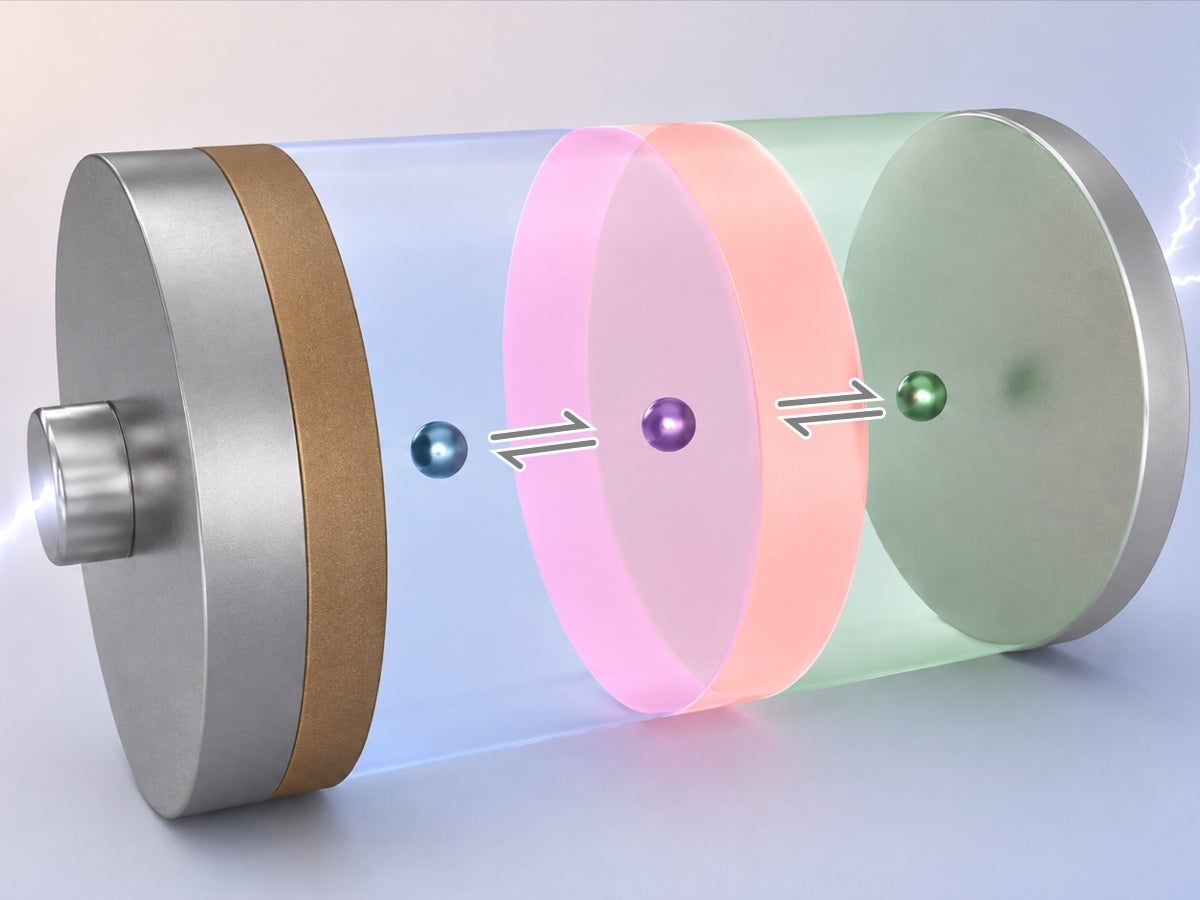
A new zinc-based battery developed by researchers from The University of Texas at Austin and partners offers a new approach to a key trade-off in one of the battery’s most important components: the electrolyte.
The electrolyte is a material, sometimes liquid, sometimes solid, that shuttles charged ions between different parts of the battery, facilitating energy delivery. There are two main types of liquid electrolytes, each with their plusses and minuses, and this new battery builds a “bridge” between them to harness their respective strengths and improve battery safety and efficiency.
Water-based electrolytes can transport ions rapidly, but their operational stability is limited by water’s tendency to split at high voltages. Organic electrolytes can withstand higher voltages but generally transport ions more slowly. This trade-off has made it difficult to simultaneously achieve safety, durability and high-rate performance in batteries.
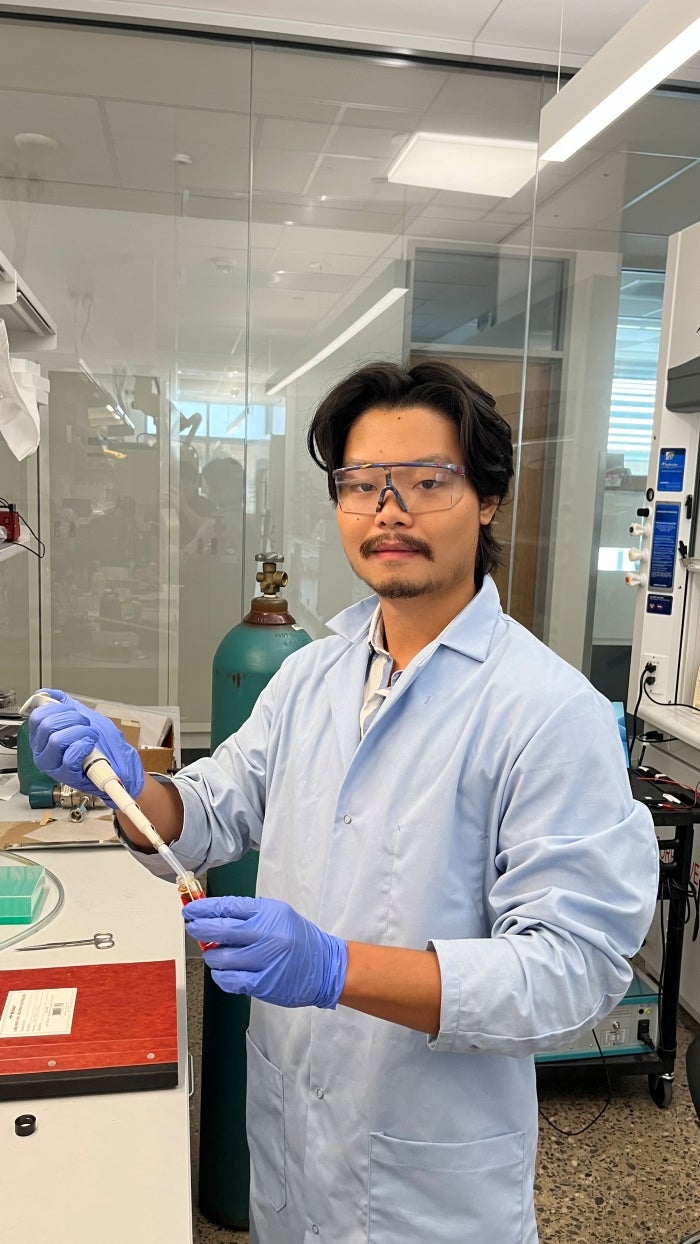
“Biphasic electrolytes allow us to combine the high stability of organic electrolytes with the fast ion transport of water-based electrolytes,” said Tianrui (Terry) Zheng, a graduate student in professor Guihua Yu’s research group who led the new research published in Advanced Materials. “The key challenge is enabling ions to move efficiently between these two very different environments.”
In addition to the bridged electrolyte, the battery is notable for the use of zinc as a key component. Zinc is abundant, inexpensive and compatible with water-based chemistries. Zinc metal costs roughly $4 per kilogram, five to eight times less than battery-grade lithium compounds.
The zinc-based, multi-electrolyte battery showed enhanced long-term stability over more than 3,000 cycles—roughly six times the cycle life of conventional electrolytes. It can fully charge in less than 2 minutes, which is typically achievable only in water-based battery systems.
Surprisingly, the key to this breakthrough came from the inclusion of molecules that wouldn’t typically go together. The team discovered that introducing molecules with both water-loving and oil-loving parts can spontaneously create a unique interphase between the water and organic phases. This interphase acts as a bridge between the two environments, allowing ions to move across the boundary from one environment to the other with low resistance.
“This work suggests a different way to think about electrolyte design,” said Guihua Yu, professor in the Walker Department of Mechanical Engineering and Texas Materials Institute. “Instead of requiring one electrolyte to satisfy every demand of a battery, we can create different environments for different functions and engineer the interface that bridges them.”
The research was funded by the Center for Mesoscale Transport Properties, an Energy Frontier Research Center supported by the U.S. Department of Energy, Office of Science, Basic Energy Sciences. The other research team members are Zhengyu Ju, Shimao Deng, Guanru Li, and professor Yijin Liu of UT’s Materials Science and Engineering Program and Walker Department of Mechanical Engineering; Sung Hoon Jung, and professor Graeme Henkelman of Oden Institute for Computational Engineering and College of Natural Sciences and Department of Chemistry; Juanjuan Huang of Argonne National Laboratory; and professors Amy C. Marschilok, Esther S. Takeuchi and Kenneth J. Takeuchi of Stony Brook University and Brookhaven National Laboratory.