
Color of Quantum
Light-manipulating material brings us a step closer to harnessing quantum mechanics.
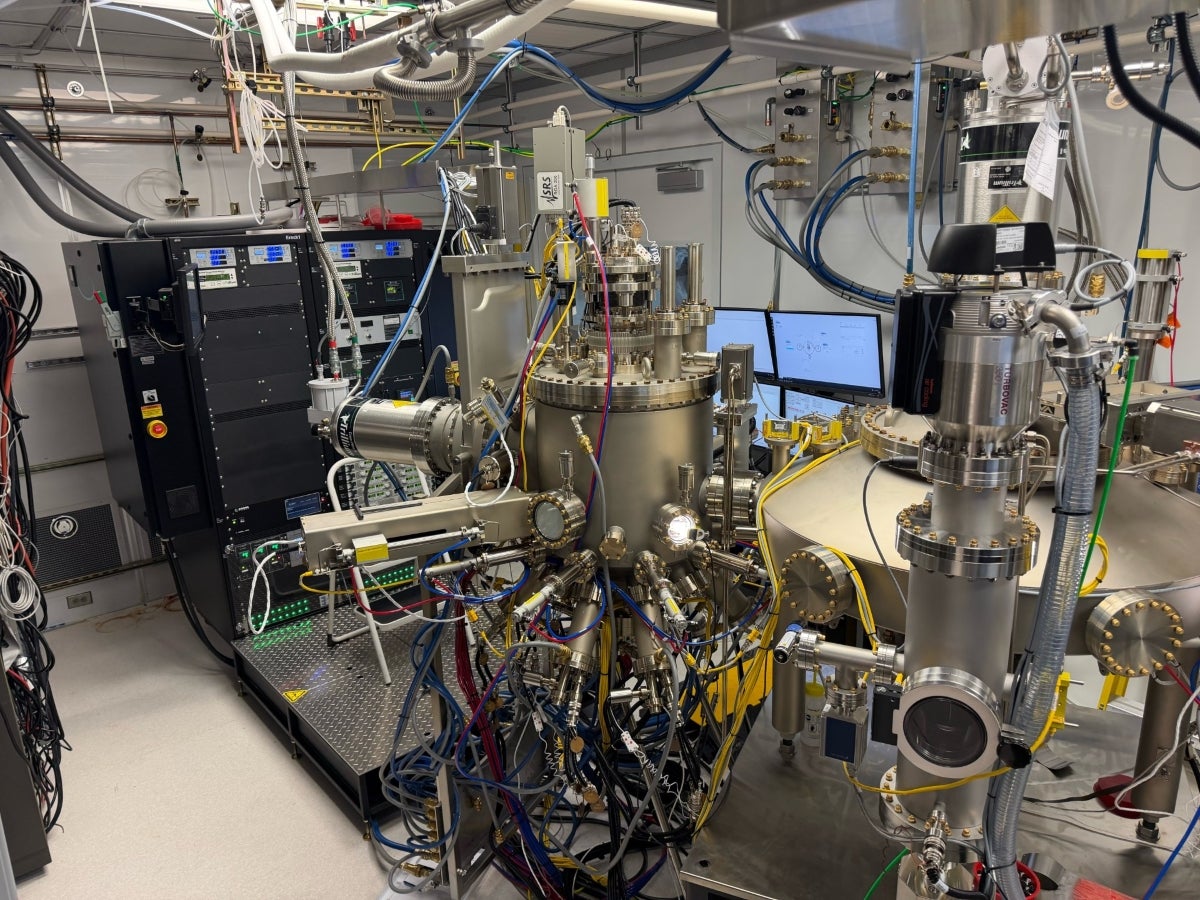
The ability to harness quantum mechanics, the mysterious dynamics that happen at the subatomic scale, depends on the ability to precisely manipulate light.
Texas Engineers, in partnership with researchers from seven other institutions, have created materials that can change the color of light at unprecedented levels. This innovation, achieved by stacking ultra-thin layers of different semiconductor materials in a specific arrangement, could pave the way for more powerful optical devices in telecommunications and quantum computing.
The materials, which the team calls “asymmetric coupled quantum wells,” were more than seven times more effective than the best conventional materials at converting light to different frequencies. The strength of this nonlinear frequency conversion in the near-infrared wavelength is fundamentally governed by the material itself, so building structures from it allows it to surpass traditional benchmarks and tailor its response as needed.

“By stacking these layers in just the right way, we can guide and transform light with a level of precision that was never possible before,” said Seth Bank, professor in the Chandra Family Department of Electrical and Computer Engineering and one of the lead researchers on the project published in Optica. “This breakthrough brings us much closer to realizing practical quantum devices that operate at the wavelengths used in today’s telecommunications.”
For decades, scientists have pursued these enhanced light-manipulation capabilities, but most traditional methods have fallen short of unlocking the full spectrum, limiting the potential of quantum devices. By alternating layers of gallium arsenide (GaAs) and aluminum gallium arsenide (AlGaAs), and precisely controlling their atomically thin thicknesses, the team created a class of “nonlinear optical materials” that is highly effective at a process called “second harmonic generation,” which, at its most basic level, involves converting one color of light into another.
The team developed ultra-thin quantum well structures that were precisely configured to engineer light-matter interactions for enhanced nonlinear optical response. By measuring the second harmonic generation, a particular form of frequency conversion, the team, with collaborators at the City University of New York, could quantify the enhancement of the nonlinear response from the new materials.
Collaborating with researchers at the University of California Irvine, the team measured the crystalline structure of the samples with atomic precision, which enabled understandings of how defects at the atomic scale affected the quantum light-matter interactions and optical frequency conversion. Altogether, this new work connected quantum-well design, crystal growth, optical measurements, and atomic-level structural characterizations to demonstrate new materials with significantly enhanced optical nonlinearities.
This process is vital for quantum technologies, where photons carry and process information rather than electrons. Manipulating these photons allows for better control, routing and detection in quantum optical circuits, which are the backbone of optical quantum computers and secure communication systems.

“The highly collaborative nature of this work, connecting quantum mechanics, material science, and optics enabled deeper insights toward the design of this new material platform,” said Rithvik Ramesh, a graduate student at California Institute of Technology, Cockrell alumnus and first author on the new research. “By engineering the quantum mechanical interactions within these structures, and understanding them through multiple interdisciplinary methods, we could bring quantum-well-enhanced optical nonlinearities to the near-infrared. The opportunities for these materials in new nonlinear optical devices is very exciting.”
Quantum computers and communication systems rely on the ability to generate, manipulate, and detect single photons with high efficiency and low loss. The new material’s enhanced properties mean that devices can be made smaller and more efficient, enabling the scaling up of quantum technologies.
Adjusting the thickness and composition of the layers allows researchers to “tune” the material to operate at different wavelengths or to optimize it for specific tasks. This adaptability is crucial for meeting the diverse needs of quantum information processing, sensing and communication.
The material platform developed in this research was used by collaborators at Harvard University to demonstrate even further enhancement of the nonlinear response through the design of metasurfaces, which are nanostructured devices on the surface of the material that manipulate light to improve the light-matter interactions in the material.
Other members of the team include Madeline Brown, Amberly Ricks, Patrick Devaney, Kevin Wen, Zarko Sakotic, Teddy Hsieh, Alec M. Skipper, Qian Meng, Sanjay Shakkottai and Daniel Wasserman of the Chandra Family Department of Electrical and Computer Engineering; Michael C. Downer and Farbod Shafiei of UT’s Department of Physics; Sedigheh Esfahani, Sander A. Mann, Michele Cotrufo and Andrea Alù of City University of New York; Moaz Waqar and Xiaoqing Pan of University of California, Irvine; Alec M. Skipper of University of California, Santa Barbara; Mark Wistey of Texas State University; Hyunseung Jung and Igal Brener of Sandia National Laboratories; and Jacob B. Khurgin of Johns Hopkins University.