
Improving Surgical Outcomes for Children, Cancer Patients
Faculty and students at the Cockrell School of Engineering are developing ways for cancer patients and children born with facial deformities to make more informed decisions about which reconstructive surgeries would be most aesthetically pleasing and practical based on their individual body types and personal preferences.
The interdisciplinary research, which includes biomedical engineering Professor Mia K. Markey and aerospace engineering Professor K. Ravi-Chandar, pairs faculty and students with doctors and patients at The University of Texas MD Anderson Cancer Center and Dell Children’s Medical Center of Central Texas.
Researchers at both medical centers are using novel 3D surface imaging technology and algorithms to address one of the most difficult questions for cancer patients and children facing reconstructive surgery: What procedure is right for me?
“With breast cancer patients, they are usually candidates for more than one kind of reconstructive surgery, and the only reason to choose one over another is the patient’s own preference,” Markey said. “So that patient may be able to understand differences in costs or how long one procedure will require her to be in the hospital, but in terms of understanding how it will change her appearance, she wouldn’t know a reason to pick one procedure over the other.”
Options Based on Patients’ Preferences
But Markey, along with a team of surgeons, doctors, and psychologists at MD Anderson, aims to change that. The researchers are in the midst of several research projects – funded by the American Cancer Society and the National Institutes of Health – to develop technology for quantifying surgical outcomes and understanding patients’ perceptions of changes in their appearance.
Traditionally, the area of a patient’s body that will be reconstructed is measured by doctors with a measuring tape. But it’s hard to know upfront which measurements are important – meaning multiple measurements may be required – and the method can be uncomfortable for patients.
Markey and her team are simplifying the process, however, by using commercially available 3D surface imaging technology. The technology takes multiple photos of patients before their surgery and builds 3D models and measurements of the photographed area in a matter of minutes.
Such models can be used to build simulations of what a patient would look like if he or she had a procedure. For cancer patients undergoing facial reconstructive surgery, the models would help better define cosmetic outcomes. And for breast cancer patients, who often must choose from multiple procedures, the simulations would make it easier to decide which procedure provides the most desired physical effect.
“We’re trying to do this in an honest way, so that these aren’t just fancy computer graphics. They provide patients with a realistic picture of what they would look like after their surgery and are constrained by what is actually surgically possible,” Markey said.
The bigger goal of one of the research projects is to identify underlying commonalities among breast cancer patients – like age, feelings on body image issues, disease history, etc. – so that surgeons and doctors can provide women with reconstructive surgery options that are more tailored to their individual needs, expectations post-surgery, and physical and mental characteristics.
Markey, along with Fatima Merchant, an engineering alumna and University of Houston assistant professor, and Michelle Fingeret, a clinical psychologist and an assistant professor at The University of Texas MD Anderson Cancer Center, are in the process of collecting up to 500 surveys from breast cancer patients undergoing reconstructive surgery at MD Anderson. Responses from the surveys will eventually help researchers create complex algorithms that – similarly to how Netflix and Amazon can predict what movies or products a person will like based on his or her shopping history and interests – a doctor could recommend surgical procedures based on a patient’s health history and desired physical appearance post-surgery.
While the surveys and research won’t benefit women currently being treated for breast cancer, Fingeret said many of them want to participate because they know the “body image profiles” derived from their responses will help another patient down the road.
“We have extremely high participation rates [in the surveys]” said Fingeret, an assistant professor in the Department of Behavioral Science with joint appointments in the Departments of Plastic Surgery and Head and Neck Surgery at The University of Texas MD Anderson Cancer Center. “When we tell people the goal of this research, they’re very interested in helping others because they’ll tell you it’s probably the most difficult decision they’ve had to make.”
The group is also leading a separate study on how cancer patients requiring facial reconstructive surgery adjust to body image issues and changes over time. In such instances, patients typically don’t have a choice over the type of reconstructive procedures because the goal of surgery is to remove cancerous tumors while maintaining or restoring as much function as possible.
The research aims to develop a way to better define cosmetic outcomes.
Creating the Face of Central Texas Children
In Adriana Da Silveira’s day-to-day job, the need to better define cosmetic outcomes for patients is great.
Children born with facial deformities such as cleft palate or hemifacial microsomia – a condition characterized by asymmetrical face and skull – pass through her office at Dell Children’s Medical Center, where she is chief of orthodontics at the Craniofacial & Reconstructive Plastic Surgery Center. Because the deformities of her patients have existed since birth, Da Silveira, Dr. Patrick Kelley, and other plastic surgeons struggle to explain to parents what their child will look like following a surgical procedure. After all, there is no frame of reference for what the child would have looked like had the deformity never occurred.
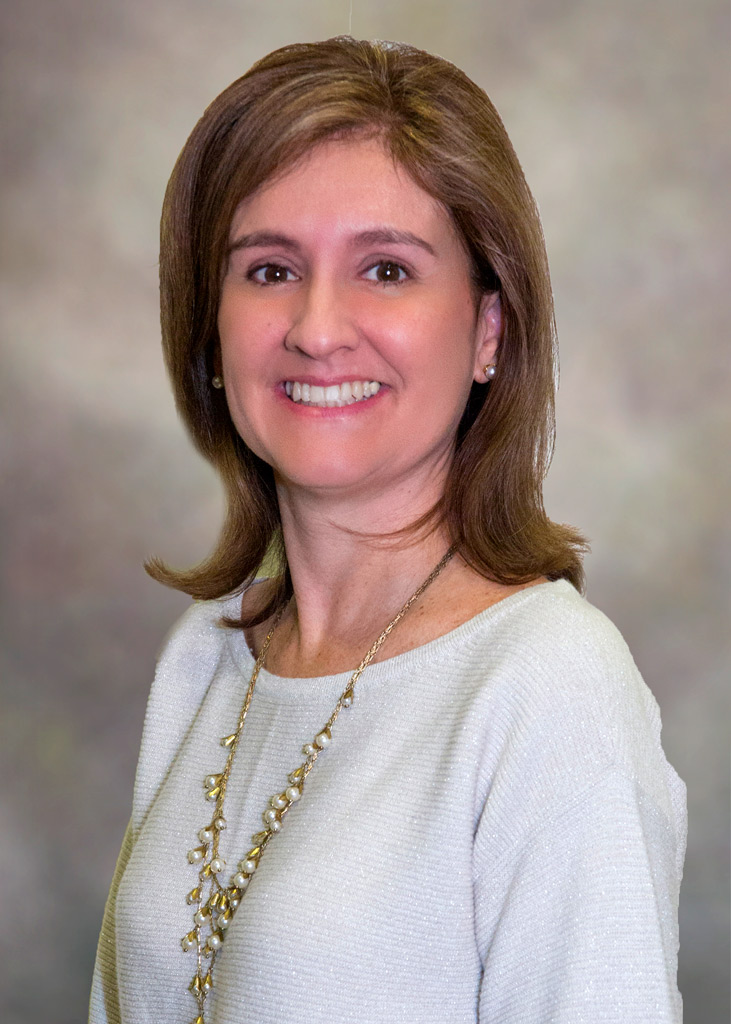
Adriana Da Silveira, chief of orthodontics at Dell Children’s Medical Center
“Basically, it’s like we’re having to guess,” Da Silveira said. “Parents want to know what their child is going to look like in the end, but when they can’t see it, and there’s no visual way to show it, they just have to trust us. And for a kid, it’s hard to say what the normal or acceptable appearance of a face is.”
Mia Markey and UT Engineering students are applying the same 3D imaging technology used at MD Anderson to eventually help Da Silveira and other surgeons.
Researchers are in the process of collecting 3D images and measurements of Hispanic children ages 7-12 who do not have facial deformities. The group represents the largest child population treated at the center, and images of them could help researchers determine what facial characteristics are considered normal or aesthetically pleasing on the face of a Hispanic child in that age group.
After a total of 80 images are collected, the attractiveness of the photos will be rated. Researchers plan to develop statistical correlations from these ratings and provide doctors with guides or computer simulations of which facial characteristics are considered most attractive, whether it is when a nose is shaped smaller, or the width of a smile is larger.
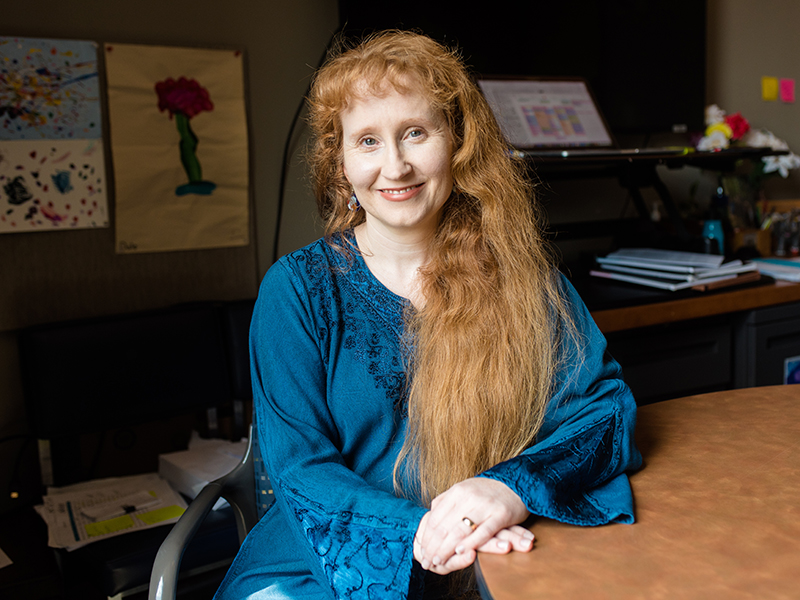
Mia Markey, professor in the Cockrell School of Engineering’s Department of Biomedical Engineering
In a sense, such advances will help put a face to Central Texas children. Along the way, they are providing Markey’s students with hands-on research opportunities that they otherwise would not receive.
“If you go into a hospital and volunteer, you’re not going to get this same level of interaction as I get here,” said Brian Ku, who will be a senior in biomedical engineering this fall and is helping lead the task of collecting images.
Ku is among a group of students – from undergraduate through postdoctoral and representing a range of engineering disciplines – who contribute to the research. The students have had the chance to watch surgeries and interact with patients undergoing reconstructive surgery – experiences that Markey says are crucial to their education.
“As I was developing my research career and thinking of the direction I could go, it was important for me to do something where people didn’t say, ‘Why?’ I wanted people to recognize its importance,” Markey said. “And with this, we can see where the research is going to help someone. So while it’s exciting to discover something new in our work, it’s equally exciting to know we can impact a person’s life for the better.”