
UT Ph.D. Students Attend Amazon AI Summit
Access, connections and feedback through the UT Austin-Amazon Science Hub were key to an invaluable experience in Seattle.
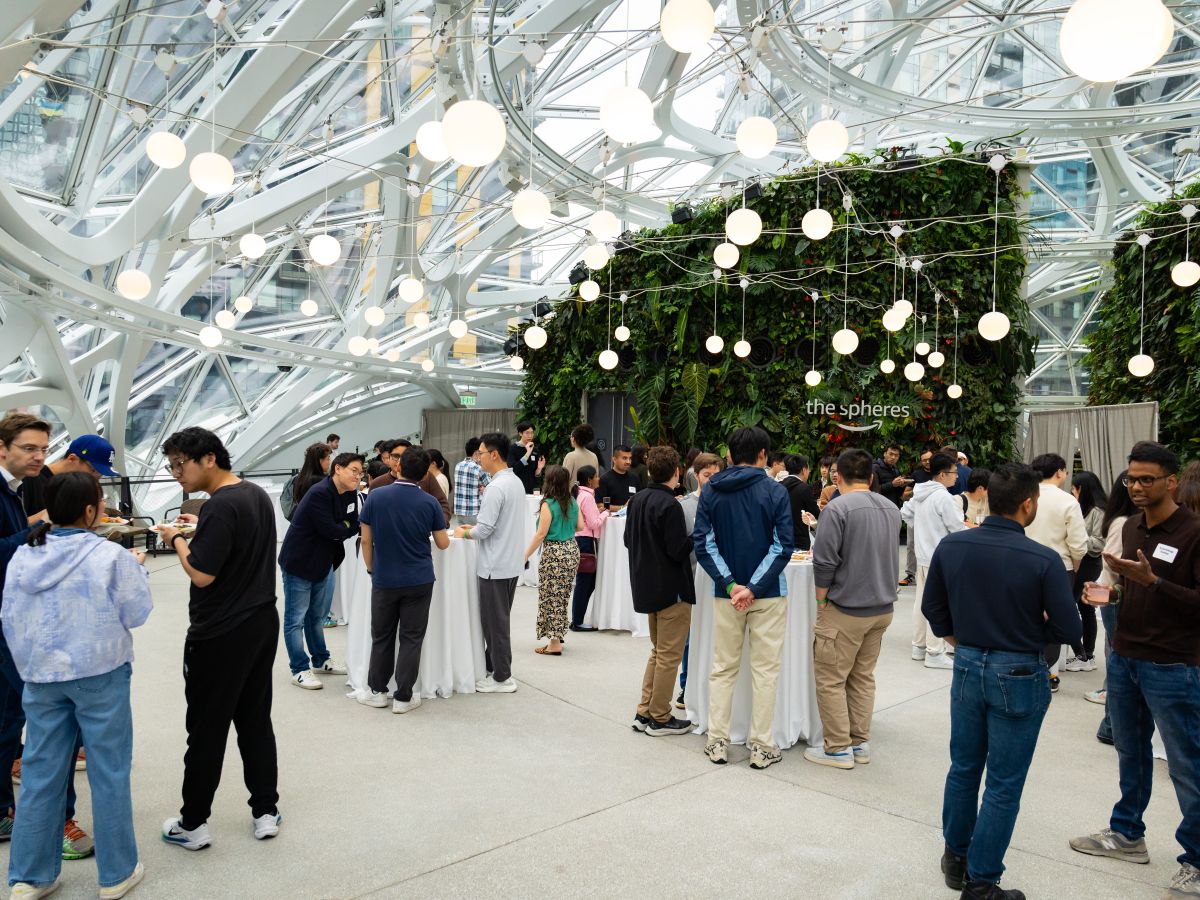
Ph.D. students from The University of Texas at Austin got a chance to travel to Seattle earlier this year to work with lead researchers and executives at Amazon headquarters as part of the UT Austin-Amazon Science Hub.
13 students (of a class of 15) represented UT at the 2026 Amazon Fellows Summit. They’re working on the forefront of AI research, with projects ranging from quantum computing to statistics to robotics.
Students from nine other universities across the country participated. They met with Amazon Web Services (AWS) CEO Matt Garman, Amazon’s SVP and Distinguished Engineer James Hamilton, among other leaders from Amazon’s AI, cloud computing, advertising and supply chain organizations at the iconic Spheres—the large urban arboretums maintained by Amazon.
“Working with Amazon has been genuinely valuable,” Avinash Kumar, an Amazon AI Fellow in the doctoral program in the Chandra Family Department of Electrical and Computer Engineering, said. “The fellowship connected me with a liaison from Amazon Science, who I meet with regularly to share progress and get feedback on my work.”
Kumar’s work focuses on making generative AI more efficient with existing infrastructure, so that the datacenters being used use less power and fewer resources.
Rohit Dwivedula, a Ph.D. in computer science, is focusing on making an AI’s resource management’s decisions more efficient. As an AI decides what to cache and store, how can we streamline this process and help it react productively to shifting priorities and workloads?
“Even though the specific use cases were diverse, a lot of the work shared a common theme: how do we use AI (especially LLMs) effectively and safely in real systems?”
Fellows presented their research on panels, through poster sessions and listening sessions with the AWS AI leadership team. Amy Zhang, a faculty mentor and assistant professor of electrical and computer engineering, participated in a featured panel discussion on the future of AI.
UT Austin Fellows received $2.4 million in AWS credits for their research and labs, storage for large LLM training datasets and complex AI experiments.
“We value our strategic partnership with UT Austin, especially our collaborations in satellite communication and robotics,” said Anne Szeto, Amazon’s director of research initiatives. “We share a culture of delivering customer and societal impact, and UT Austin’s commitment to graduate research is clear in their strong presence in our AI PhD Fellowship program.”
“The credits are helping extend my research beyond my own papers, supporting experiments by undergraduate students I mentor at UT Austin and UW–Madison, in collaboration with researchers at both universities,” Dwivedula said.
Beyond relationship building, the researchers and industry leaders benefited from challenging each other on the next steps for the technology.
“Overall, the access, feedback, and resources continue to meaningfully support my development as a researcher,” Kumar said.
